Free association contains elements of several other idea-generating techniques and depends on a mental ‘stream of consciousness’ and network of associations of which there are two:
Serial association, start with a trigger, you record the flow of ideas that come to mind, each idea triggering the next, ultimately reaching a potentially useful one.
Centred association, (which is close to classical brainstorming) prompts you to generate multiple associations to the original trigger so that you ‘delve’ into a particular area of associations.
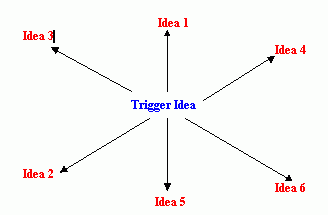
As a rule the serial mode is used to ‘travel’ until you find an idea that you find of some interest, you then engage the centred mode to ‘delve’ more deeply around the interesting item. Once you have exhausted the centred investigation, you being to ‘travel’ again, and so on. Three hints:
- Suspend judgement. Try not to repress your natural flow of thoughts.
Unusual ideas, that may seem ‘off the wall’ are perfectly
acceptable, such as:
- Rude ideas
- ‘Not you’
- ‘Silly’
- ‘Taboo’
- ‘Unethical’
- ‘Tactless’
- ‘Politically incorrect’
-
They are acceptable because they are thoughts you generally suppress; they could be an alternative starting point promoting all sorts of possibilities. Undoubtedly and ‘open’ strategy requires a ‘safe’ environment where the use of a variety of material is fully recognised and understood. Friendly laughter can be a breathtaking cure for any passing awkwardness that free-expression may cause!
-
Follow the intriguing and look for ideas that attract your attention as particularly strong, intriguing, surprising, etc. even if they don’t seem instantly appropriate to your problem. This attraction frequently signals links to a useful set of associations, and so could possibly justify a further phase of centred free association around the ‘attractive’ idea.
-
Use solution-oriented phrasing. The idea ‘blue’ is not much use as it stands. However, when transformed into a phrases such as:
- ‘Could we colour it blue?’
- ‘In what ways might I make it ‘blue?’
- ‘I wish it were ‘bluer’
- ‘How might it help it if were bluer’?’
Makes the idea ‘blue’ potentially a more useful one.