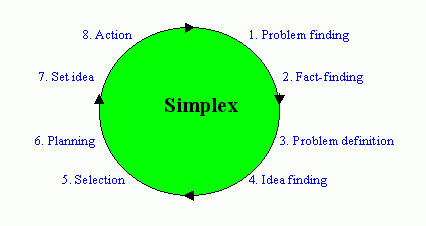
This technique is an industrial-strength creativity tool, which takes the DO IT method to the next level of sophistication. Rather than seeing creativity as a single straight-line process, Simplex views it as the uninterrupted cycle it should be, where completion and implementation of one cycle of creativity leads straight into the next cycle of creative improvement (see the 8 stage cycle that simplex uses below)
1. Problem Finding
Discovering the right problem to resolve is the most difficult part of the creative process. The problem may be obvious or need to be flushed out using rigger question such as:
- What would your customers want you to improve?
- What could they be doing better if we could help them?
- Who else could we help using our core competences?
- What small problems do we have which could grow into bigger ones?
- What slows our work or makes it more difficult? What do we often fail to achieve?
- How can we improve quality?
- What are our competitors doing that we could do?
- What is frustrating and irritating?
These questions deal with problems that exist now. At this stage you may not have enough information to formulate your problem precisely. Do not worry about this until step 3!
2. Fact Finding
The next phase is to locate as much information relating
to the problem as possible.
This gives you the depth of knowledge you need to:
- Use the best ideas your competitors have had
- Understand customers needs in more detail
- Know what has already been tried
- Fully understand any processes, components, services or technologies that you may need to use
- Ensure that the benefits of solving the problem will be worth the effort you will put into it
This phase also involves assessing the quality of the information that you have. Here it is worth listing your assumptions and checking that they are correct.
3. Problem definition
You should now have a rough idea of what the problem is and should have a good understanding of the facts relating to it. You should now develop the exact problem or problems you want to resolve.
It is essential to solve a problem at the precise level.
If you ask questions that are too broad, then you will never have enough
resources to answer them effectively. If you ask questions that are
too narrow, you may end up fixing symptoms of a problem, rather than
the problem itself.
Min Basadur (who created the Simplex Process) suggests using the question
'Why?' to broaden a question, and 'What's stopping you?' to narrow it.
For example, if your problem is one of plants overgrowing, ask 'Why
do I want to kill them off?' This may broaden the question to 'How can
I maintain the quality of our environment?
4. Idea Finding
This phase requires you to generate as many ideas as possible; this can be done using any range of techniques from asking other people for their opinions, through programmed creativity tools and lateral thinking techniques to Brainstorming. Remember bad ideas often trigger good ones.
5. Selection & Evaluation
Once you have come up with a variety of possible solutions
to your problem, it is time to decide on the best one. The top solution
may be obvious, if it is not, then it is important to think through
the criteria you will use to select the best idea. There are several
good methods for this, particularly useful techniques may be Decision
Trees, Paired Comparison Analysis and Grid Analysis.
When you have chosen an idea develop it as far as possible. Then it
is essential to evaluate it to see if it is good enough to be worth
using. It is important not to let your ego get in the way of your common
sense. If your idea does not give big enough benefit, then either see
if you can generate more ideas, or restart the whole process. You can
waste years of your life developing creative ideas that no one wants.
6. Planning
Now you have selected an idea, and are confident that your idea is worthwhile, this is the time to plan its implementation. The best way of doing this is to set this out as an Action Plan, which lays out the Who, What, When, Where, Why and How of making it work. For large projects it may be worth using more formal planning techniques.
7. Sell Idea
Up to this stage you may have done all this work on your own or with a small team. Now you will have to sell the idea to the people who have to maintain it. This might be your boss, a bank manager or other people involved with the project.
In selling the project you will have to deal with not only the practicality of the project, but also things such internal politics, hidden fear of change, etc.
8. Action
Finally, after all the creativity and preparation,
comes action! This is where all the careful work and planning pays off.
Now the action is securely under way, return to stage 1, Problem finding,
to continue improving your idea.
[source : www.mycoted.com
]
- R. V. Olson, The Art of Creative Thinking, Perennial Library
1980