CLASS
B
PHASE
APPLICATION FIELDS
- Improvement/tasks: to deeply examine an on-going thing or the methods used commonly to deal with a task. In fact, this technique can underline a relevant concept and then the attention can shift on the methods to realize operatively that concept.
- Problems: this technique is used in case a considerable creative effort is necessary;
- Projects;
- Forecasting of future trends;
- Strategy;
PROS
It is a very systematic method, which proceeds step-by-step
and lets emerge a lot of new fix points
CONS
Sometimes this technique let emerge ideas, which
may be useful but not always innovative.
DESCRIPTION
Concepts fan is an elaborate system for seeking alternatives by means of concepts, which constitute a series of fix points: each of them will be the basis for a subsequent seeking. It is particularly useful for the so called “realizing thinking”, which entails the solution of a problem or the execution of a task.
This technique is based on the principle of “doing a step backwards”: starting from an aim, we move back reaching to general concepts or “directions” to be taken to achieve the goal. Then, starting from the “directions”, we move again back reaching to other “concepts” or means to follow those directions: in other words, each general concept or “direction” becomes the fix point to seek alternative “concepts”. Finally, from concepts we go back again and we find the “ideas”, which are the operative ways to realize concepts.
Concepts fan is constituted, therefore, by three levels:
- Directions: the most general concepts occurring.
- Concepts: general methods to do something.
- Ideas: operative and specific methods to realize a concept.
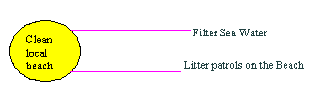
- A circle is drawn in the middle of a big sheet and inside this circle
the problem requiring a solution is written. For example, a problem
could be “Clean local beach” (yellow circle in Fig. 1);
- On the right of the circle lines are drawn, representing possible
solutions to the problem (pink lines in Fig. 1). In the considered example:
Problem: Clean local beach.
Ideas: Filter sea water;
Litter patrols on the beach;
Fig. 1– Diagram of phases 1-2
Source: www.mycoted.com
- It is possible that the obtained ideas are not feasible or that they
do not solve really the problem. If this is the case, the principle
of “doing a step backwards” is applied to a wider problem
analysis. According to this, another circle is drawn on the left of
the first one and a wider definition of the given problem is written
inside of it. This new circle (green) is linked to the first one by
an arrow, in order to demonstrate that it is derived from it (Fig.2).
Initial problem: clean local beach;
Widened problem: control pollution entering the sea;
Fig.2 - Diagram of phases 1-2-3
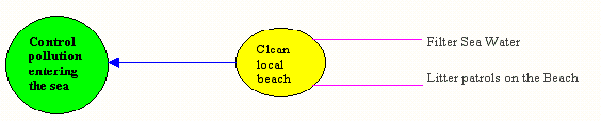
Source: www.mycoted.com - This new circle will be used as starting point to generate new ideas. If solutions are not found, another step back could be done (and so on) until a "winning idea" is reached.
CORRELATE
TECHNIQUES
REFERENCES
- De Bono E., Serious Creativity Using the Power Lateral Thinking to Create New Ideas, The McQuaig Group, 1992 (trad. it. Severo Mosca, Essere Creativi. Come far nascere nuove idee con le tecniche del pensiero laterale, Milano, Edizioni Il Sole 24 ORE, 1998).