This technique although similarly named is quite different from the Cartoon Story Board technique. It is an ‘idea’ organizing’ method using tree logic (c.f. Mind-Mapping, and other hierarchical diagrams and outlines, and Venn-convention methods such at Snowball Technique, and KJ-Method).
The facilitator is more able to concentrate on idea-generation of particular topics and sub-topics much more closely than is usually possible in open-ended methods (c.f. Constrained Brain writing as another way to achieve this).
Cards are laid out in a tabular format – a simple row of header cards (or possibly header and sub-header cards as in the example below), each with a column of idea cards below it, perhaps with added action or comment notes attached (index cards or Post-it slips could be used):
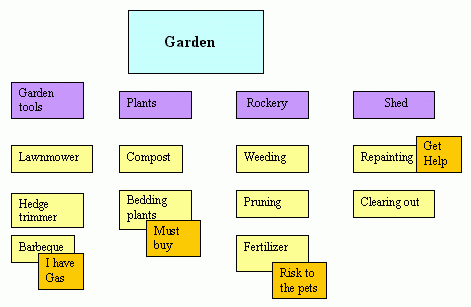
Using different shaped or coloured ‘header’ cards to make them more striking is helpful. The semi-sticky adhesive used on re-stickable notes is available in spray-can form, so if you want to use non-sticky cards, you can make a re-stickable display area by spraying flip-chart paper with the adhesive; the cards can then be put in position or removed and rearranged as you wish. One possible approach is as follows:
- The group leader describes the problem to the participants; they
then suggest possible categories of solutions. These are written
on cards and displayed as a row of ‘headers’.
- The group leader selects a particular ‘header’ and
participants write ideas relating to that header on cards. These
idea-cards are displayed under the relevant header, followed by
the leader posing provocative questions to prompt further idea-cards
under that header. This process is repeated with other headers,
until there is an adequate supply of ideas. If necessary, return
to Step 1 to generate further headers, and/or add sub-header cards
under a particular header card
- The idea cards should no be ranked via a suitable voting method and arranged in priority order under each header (or sub-header). The best three in each category are discussed further, and ranked amongst themselves
Smithers (1984), of the Creative Thinking Centre, adds a introductory problem clarification stage by initially putting up a header saying ‘Purpose’ and then getting the group to develop idea-cards under this header for different aspects of the ‘Purpose’ of solving the problem. The headers for the idea-generation stage are then created as a result of this initial stage, one group member writes the cards, another member pins them up, allowing the group leader to concentrate on facilitation.
FASTTRACK, a fully developed problem-solving process devised by Bauer and Associates (1985), makes extensive use of card story boards. They use a
· ‘Why?’ header (equivalent to Smitters’
‘Purpose’),
· ‘Miscellaneous’ header (for use where there is
disagreement about the category of an idea)
· ‘Wild Card’ header (where all rejected ideas are
stored)
· ‘Causes’ header (for evaluation)
· ‘Consequences’ header (for evaluation)
· ‘Essential Criteria’ header (for evaluation)
· ‘Solution ideas’ header (for evaluation)
· ‘Selected solution(s)’ header (for evaluation)
· ‘Action Steps’ header (for evaluation)
· ‘Assessment Steps’ header (for evaluation)
These establish a very compact summary of the problem and current ideas about dealing with it, in a system that is easily adjusted.
You can also use header cards to represent procedural
elements or steps (instead of idea categories) with the idea-cards listing
the results of that step.
[Source: www.mycoted.com]